

- Personal Memory keeps your language, expression, and collaboration preferences.
- Project Knowledge keeps project structure, design rationale, change relationships, and verified engineering experience.
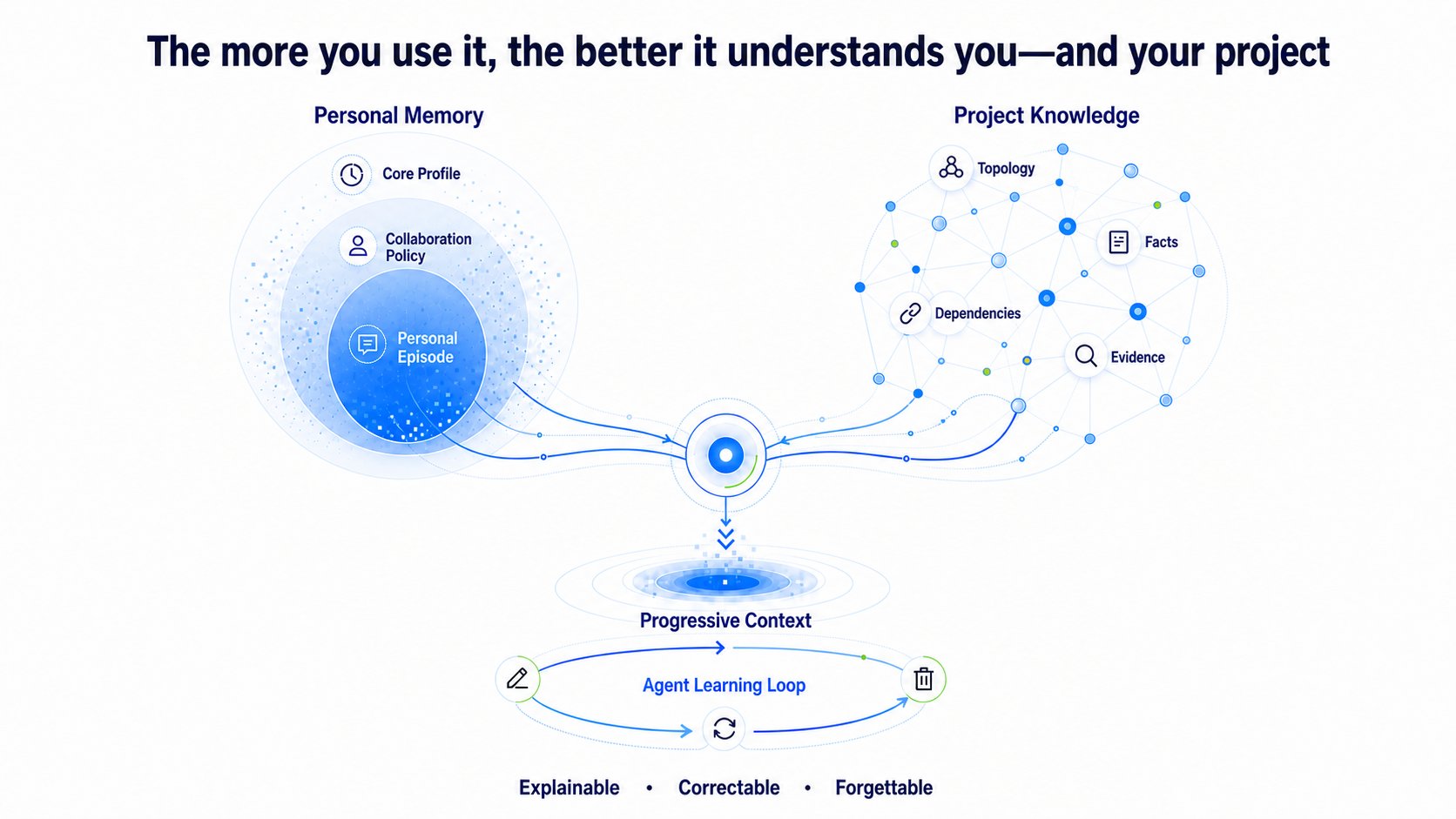
How common scenarios are handled
Comet’s goal is a better starting point for the Agent. The current code, configuration, tests, and Runtime state remain the direct basis when you execute a task.
Industry practice and Comet’s trade-offs
Mainstream coding agents typically add cross-session context from three directions:
Claude Code separates the hand-maintained
CLAUDE.md from automatically formed memory; GitHub Copilot Memory separates repository facts from user preferences; Cursor Rules controls instruction loading by path and relevance; Qoder Knowledge Engine organizes project understanding into an agent-facing knowledge layer.
Each long-lived record keeps an owner, source, scope, source status, and application result, so you can view, correct, and trace why a record entered a task.
Responsibility layers
Project Knowledge helps the Agent understand the project, Rule provides team instructions, and Hook and engineering checks enforce constraints deterministically.
Key concepts
From experience to task context
1. Record experiences with a clear scope
Classic, Native, Hotfix, and Tweak hand structured events to the same learning channel. Valid signals include:- An explicit request to remember, correct, or forget;
- The actual result after a task completes;
- A verification that succeeded or failed;
- Processed Review conclusions;
- Faults whose root cause was confirmed, fixed, and re-verified;
- The final decisions after a change is archived;
- The result after a piece of context was applied.
2. Distill reusable conclusions
Explicit long-term requests take effect through fixed rules right away. For example, after you say “answer in Chinese by default from now on”, Personal Memory can apply it immediately. Experiences that need semantic induction are processed by Reflection in the background. For example, when a Review confirms that a certain type of change must also update the registry, the system checks whether the conclusion was accepted, whether the change was completed, and whether verification passed, and only then decides whether to form a project policy. Consolidation merges similar content, adds new evidence, tightens the scope, and keeps invalid records out of later tasks.3. Match the current task
Context Director filters candidates by the current project, path, task, operation, and phase. Key profiles and a few verified policies can be provided in full; other relevant content enters the Context Manifest. Each Manifest item contains a stable ID, title, source type, andwhyApplied. whyApplied states which concrete condition the content matched in the current task. When the Agent needs the full text, source, or verification method, it expands the item by stable ID.
4. Record application results
After content enters a task, the Agent can report these results:
Application results affect later ranking, status promotion, content rewriting, or replacement. Delivery does not establish adoption:
comet task feedback can include --decision, --verification, and --verification-result passed|failed alongside --application and --outcome to record the actual decision, verification command, and result. The Dashboard displays this evidence separately from delivery records.
Evidence and lifecycle
Automatically formed content must be verified and reused before it can get a higher priority. Comet keeps these states for a record:
Forgetting writes an independent tombstone. When Comet replays historical events it recognizes the tombstone, so forgotten content never takes effect again.
Failure isolation
Add, correct, forget, and expand are operations the user is waiting on. When one fails, Comet returns the real error and keeps the original state. When background capture, Reflection, retrieval, or a Learner fails, Comet records the diagnostic and continues the current workflow. Personal Memory and Project Knowledge use separate Providers, storage, and scopes, so one plugin’s failure never interrupts the other kind of long-term context.Product boundaries
Agent Learning Loop produces viewable, correctable, traceable external context. It does not train or fine-tune the model, and it respects these boundaries:- Never saves full chats, full task traces, or hidden reasoning;
- Never publishes personal project habits as team knowledge automatically;
- Never overwrites
AGENTS.md, Rule, Skill, or project configuration; - Never auto-generates linter, test, build, or CI configuration for an unknown stack;
- Never expands permissions for operations such as commit, push, delete, and publish.