


Agent Skill Harness
From idea to reliable delivery
All it takes is
/comet
Comet Skill keeps agents on track through long-running work with recoverable state. Comet Eval tests Skills on real tasks and turns results into evidence for iteration. /comet-any composes existing Skills into reusable capabilities.
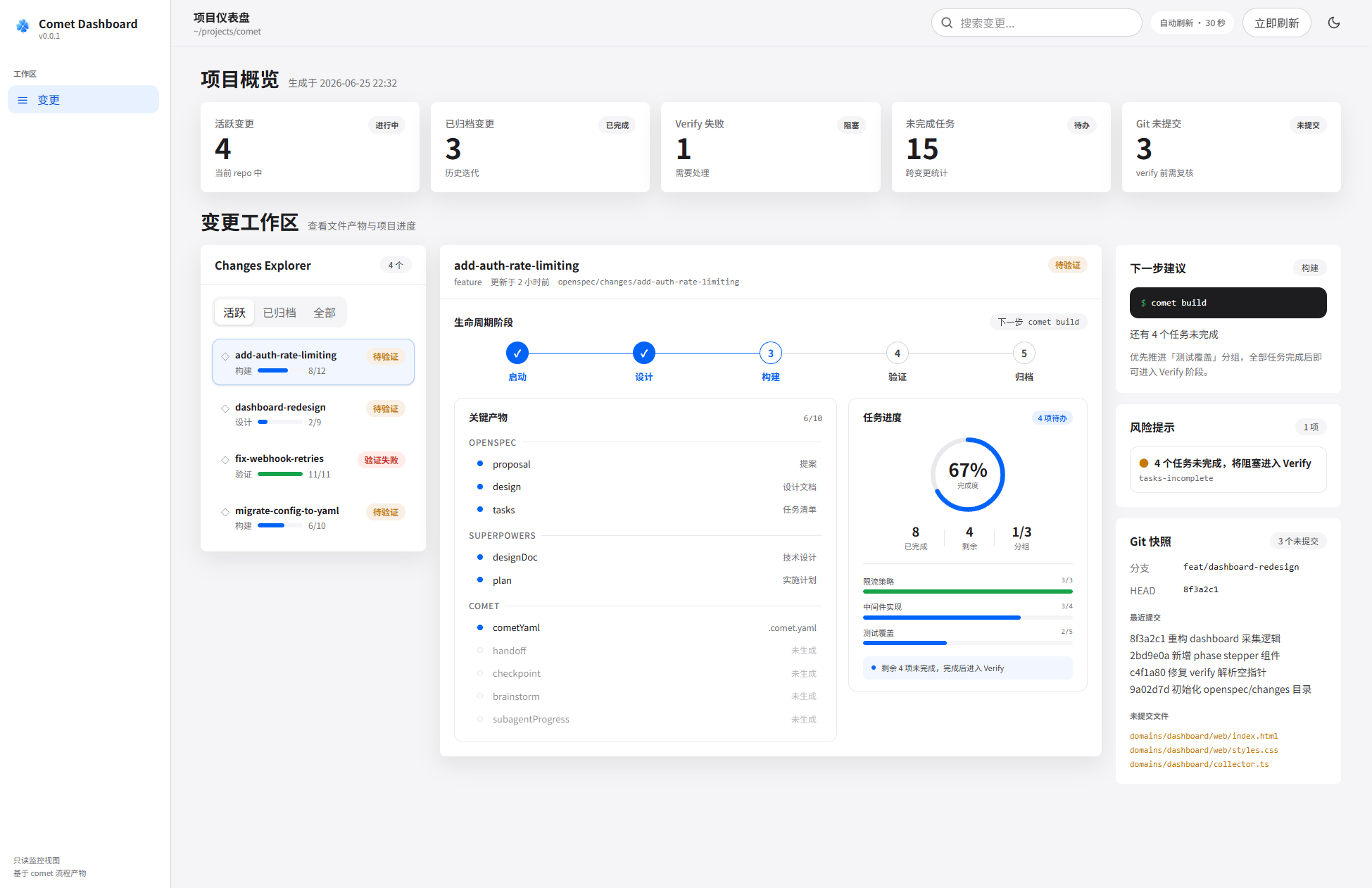
Comet Skill
Two modes, one set of phase guards
Call /comet in your AI coding tool. Comet enters Native or Classic mode from the project configuration and moves each change from idea to archive. Even after an interruption, context compression, or a device switch, you can continue from the same state.
Strong models · Fully automated coding
Designed for strong models such as Fable 5 and GPT 5.6 that can complete complex coding work autonomously. The model clarifies requirements with structured questions and drafts a target Spec for your confirmation. Comet guards clarification, the target Spec, and result verification while the model handles implementation.
Classic Spec-driven · More HITL
An Open → Design → Build → Verify → Archive workflow that connects OpenSpec and Superpowers. Design Docs and explicit confirmation points constrain each phase, making it suitable for larger changes that need a rigorous process and for models below the Fable tier.
Both modes share the same phase guards: cross-phase writes are blocked, confirmation points cannot be skipped, and state remains recoverable.
Explore the workflow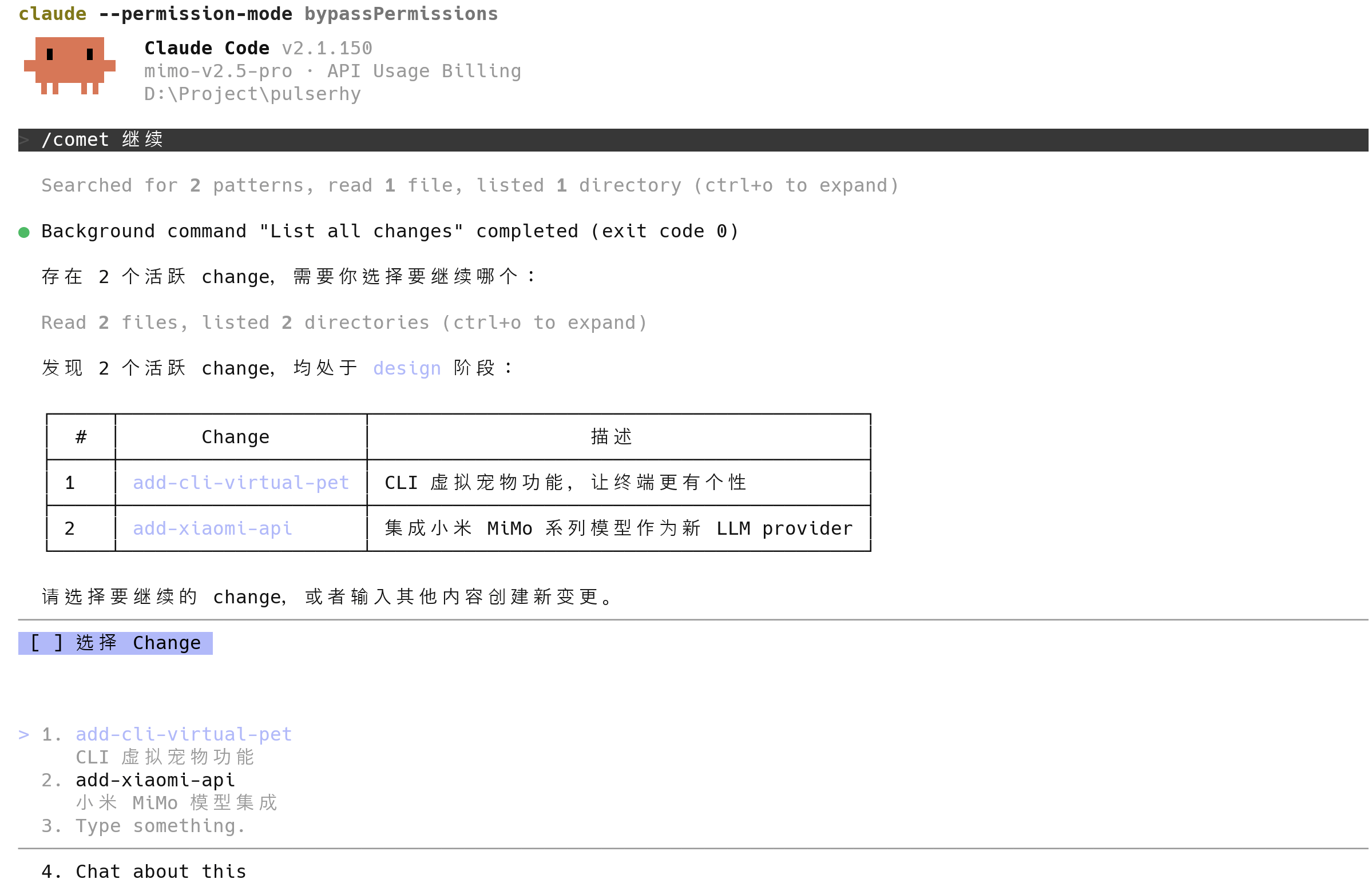
Comet Eval
Validate every Skill
with real tasks
Comet Eval uses a dual-agent evaluation architecture. The agent under test runs the Skill while a user-simulation agent responds at decision points.
The —resume option continues the same session so multi-phase workflows can run end to end.
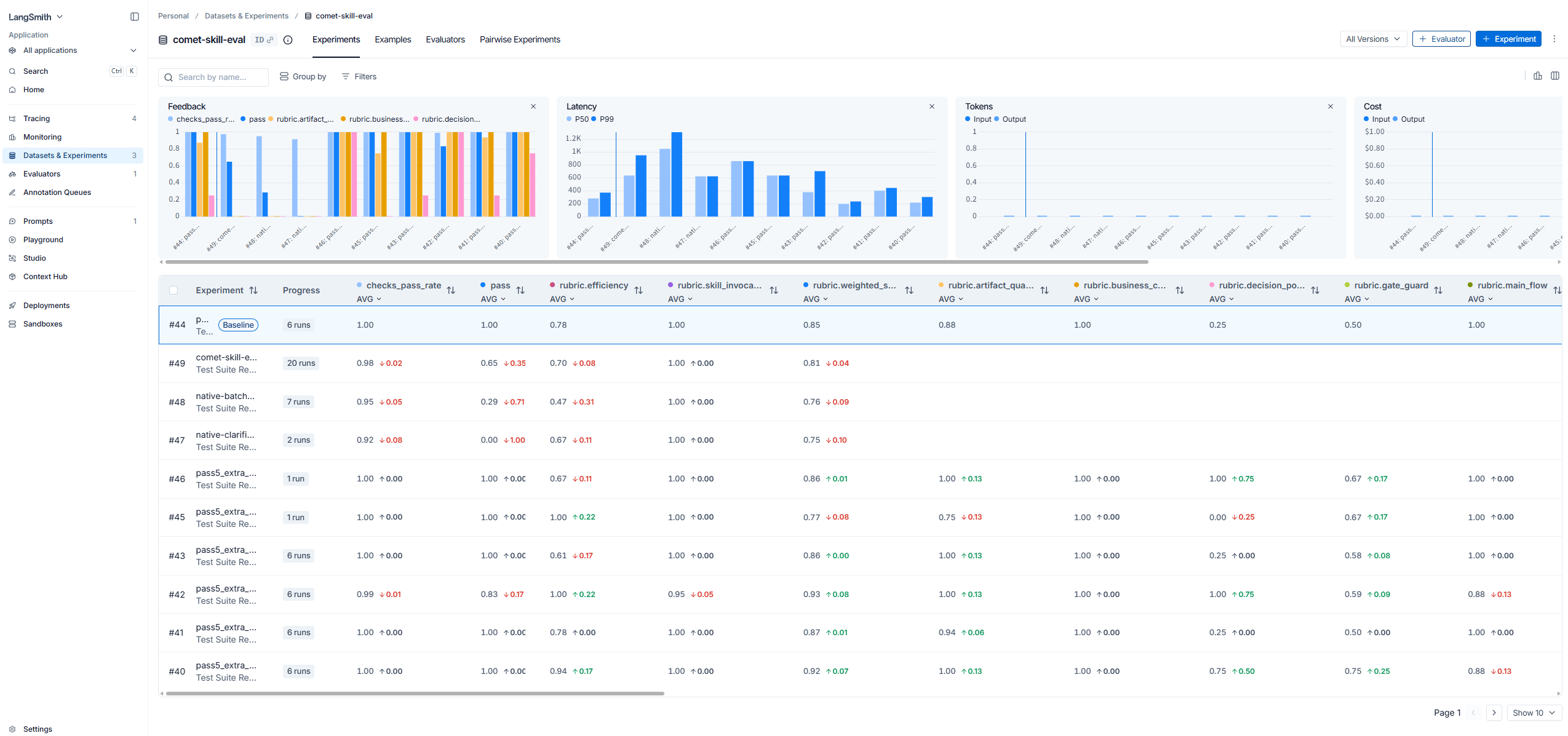
Give any local Skill to comet eval to run real tasks in an isolated environment and produce browsable results, multidimensional scores, and failure attribution.
- LangSmith / Langfuse integration — Send traces, datasets, and scores to LangSmith or Langfuse for cross-run observability, comparison, and review.
- Production-ready evaluation — Run real tasks in isolated environments with multidimensional rubrics, Pass@k / Pass^k, and failure attribution across Harness / Workflow / Task / Model layers.
- Evidence-driven Skill iteration — Replace intuition with measurable evidence that informs whether a Skill should ship and how it should evolve.
Skill Creator
Turn how you work
into a reusable Skill
Use /comet-any to create, compose, or refine any Skill.
Confirm the approach and Workflow Contract before evaluation, publishing, and distribution, turning one-off experience into a reusable capability.
- Compose any Skill — Orchestrate existing Skills such as brainstorming, writing-plans, and TDD into a new workflow.
- Workflow Contract — Agree on phases, confirmation points, and deliverables before implementation begins.
- Evaluate and publish — Evaluate, package, and publish directly after creation, with every Skill revision remaining traceable.
Why Comet
Engineering scaffolding for reliable long-running work
ReAct handles single-turn reasoning. Comet adds state management, phase guards, and result evaluation for the complete workflow, moving work reliably from idea to archive.
- 01
Phase guards
Phase boundaries, confirmation points, and verification requirements prevent critical steps from being skipped and block out-of-phase operations.
- 02
Recoverable state
Phases, decisions, evidence, and failures are stored in the project so work can continue after interruptions, compression, or device changes.
- 03
Intent routing
/cometreads project configuration, active state, and current intent to enter the correct workflow and continue existing work. - 04
Evaluation-driven
Real-task scores and failure attribution replace “it feels usable” with measurable progress.
- 05
Context compression
Goals, decisions, state, evidence, and next steps are stored in a structured form so the context needed to continue survives conversation compression.
- 06
Skill composition
Orchestrate existing Skills into new workflows and turn them into reusable capabilities that can be evaluated and published.
33 platforms
Run in the tools you already use
Comet supports 33 AI coding platforms. The initialization wizard installs and configures Comet for each detected platform.
Live setup
From npm install to your first /comet
Install Comet and initialize the current project.
Then call /comet in your existing AI coding tool to begin.
- 01
Install the CLI
Install
@rpamis/cometglobally with npm so the Comet command is available in your terminal. - 02
Initialize the project
The wizard writes Skills, rules, and phase guards, then configures every detected platform.
- 03
Start working
After setup, call
/cometdirectly in the AI coding tool you already use.
Ready for work
Ready to begin?
Comet guards each phase, preserves state, and evaluates results.
Bring your next task and start from there.
Comet Skill
Keep agents within phase boundaries, preserve state, and continue long-running work after interruptions.
Comet Eval
Run real tasks with a dual-agent architecture and produce scores, evidence, and failure causes.
Comet Any
Compose or refine existing Skills into reusable capabilities that can be evaluated and published.