

comet init. Comet currently supports 37 AI coding platforms.
A comprehensive overview of all platforms
The following table lists all platforms, platform ids (for CLI--platform <id>), project-level Skill directories, global Skill directories, and the capabilities supported by each.
Complete capabilities (Skill + rules + hooks
Skill + hooks (Random)
Skill + Rules (Without hooks
Only Skill (no rules, no hooks
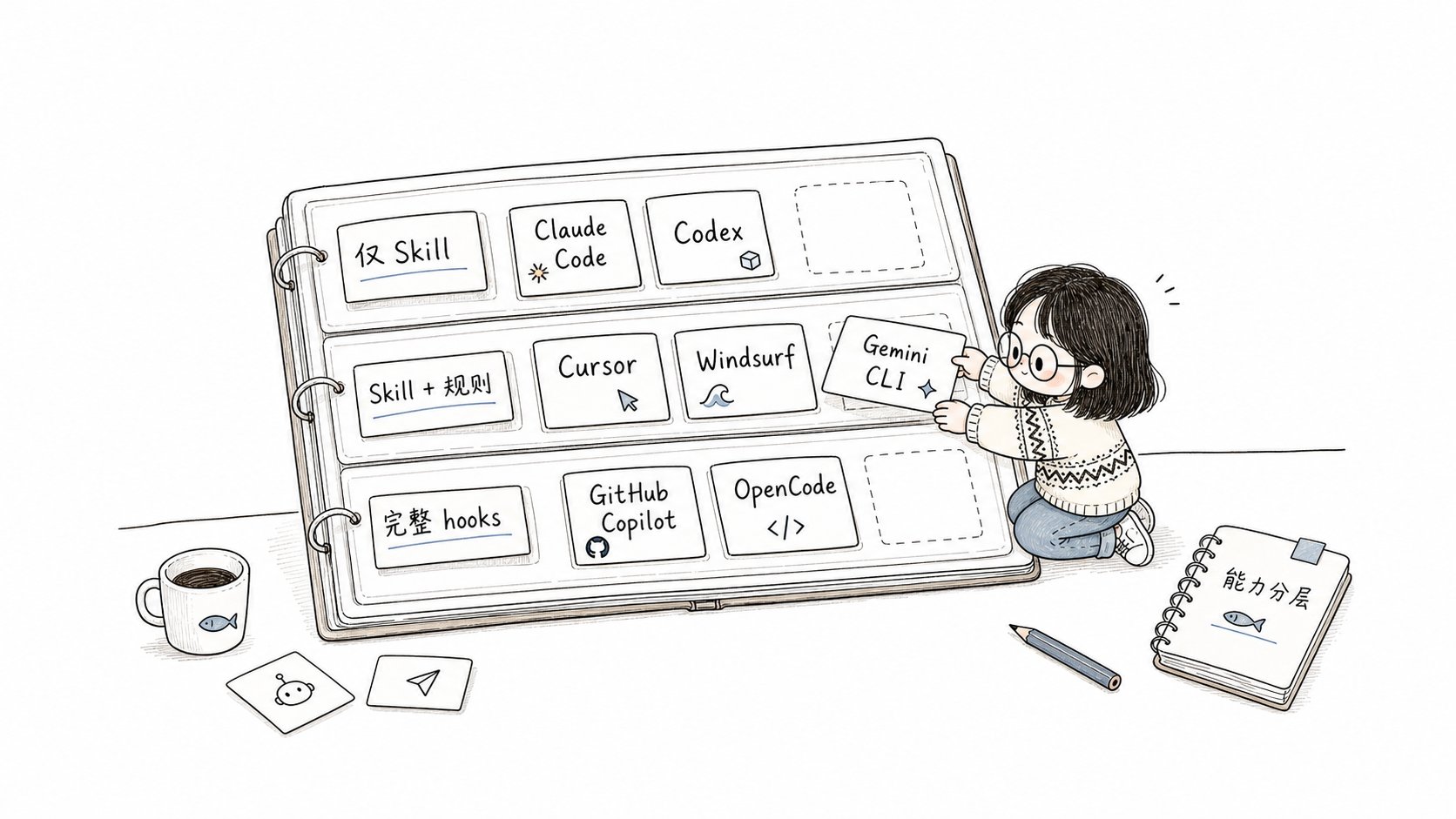
platform supports layer-by-layer enhancement of
by Skill, rules, and hooksSummary of Capabilities
Rule format
Comet supports four rule formats:Hooks format
The 16 Hook platforms in the current list use 11 hook formats:OpenCode is a platform
OpenCode, ZCode, and MimoCode are all based on the OpenCode runtime and support Opencode-style slash commands and image OpenSpec outputSpecial installation path
The global installation directories of the following platforms are different from the project-level directories:
Global installation on other platforms uses directories with the same name (for example, Claude Code is globally
~/.claude, CodeBuddy is globally ~/.codebuddy, and WorkBuddy is globally ~/.workbuddy). Junie, CoStrict, Crush, Factory Droid, iFlow, Bob Shell, ForgeCode do not support global installation.
WorkBuddy project level Skill in
. WorkBuddy/skills/, user level Skill in
~ /. Workbuddy/skills/. Hook blocking only writes to the project-level
. Workbuddy/Settings. Json; Global installation does not add global blocking
Hook, so there is no need for Hook configuration outside the project.The Skill discovery root of Codex is different from the configuration root: project and global skills use
. Agents/skills, Codex exclusive configuration, rules, hooks and plug-ins are still located in cache
.codex. update/uninstall version 0.4.0-beta.4 will migrate the old managed by Comet
codex/skills installation, and leave the other Skill and the Shared directory. 0.4.0 - beta. 5
Guard hook rewriting, the Codex stage to the supported . Codex/hooks. Json. Grok
Also USES Claude - code hook format, but write . Grok/hooks/comet json
And additional matching Grok native write/search_replace tools.Antigravity and Antigravity 2.0 share project-level
.agents/ skills
The table of contents, so comet init
Both will be selected simultaneously during automatic detection. If you only want to install one of them, you can do so in the interactive installation process (without )
Manually uncheck the other one in —yes.Choose project-level or global
Installation mode: Copy vs symbolic link
Aftercomet init and comet update select the platform, they will ask for “install mode”. Starting from 0.4.0-beta.1, a new symlink mode has been added:
The working mode of Symlink mode
After selecting Symlink, Comet no longer copies Comet Skill for each platform. Instead, it creates symbolic links for Comet Skill in the existingskills/ directories of each platform, pointing to the central .comet/skills/ of the project:
comet update, only the central storage needs to be updated, and it takes effect immediately on all platforms. The terminal summary will display symlink created or symlink creation failed.
If the target platform already has its own
skills/ directory, Comet
The directory and the local/third-party skills within it will be retained, and only the links managed by Comet will be created or refreshed.Which mode is chosen does not affect Comet’s behavior; it only influences how files are landed on the disk. When submitting to the repository, Copy
The mode will generate real files; The Symlink pattern generates symbolic links (usually requiring each team member to )
comet init)。General skills Registry Platform
Some AI coding platforms manage skills through the universalskills CLI registry. For these platforms (including OpenClaw, Hermes, etc.), install the Comet skill package directly using the common command:
comet init without any conflict.
hooks and executable capabilities
Some platforms support hooks. Comet will non-destructively merge the hook configurations it manages and retain the existing configurations of users. If there are already plugins, hooks or other user Settings in the file, Comet will retain them. If the JSON cannot be parsed, the installation will explicitly fail and the original file will remain unchanged.Verification after installation (not mandatory
doctor will provide a diagnosis. Run when an update is needed: