

Goal-driven Agent development model
Native is the requirement workflow designed by Comet for strong models. Models such as Fable 5 and GPT-5.6 have been able to independently investigate code, formulate solutions, and select testing strategies based on risks. For this type of model, continuing to enforce the application of fixed design, planning and TDD processes will bring limited additional benefits. Native only stipulates two things:- ** Fix the requirements ** : Use
brief.md(which records the goals, scope, non-objectives, and confirmed user decisions) and the complete target Specs to clarify “what to do”. - ** Determine completion with evidence ** : The Runtime runs necessary checks, and then the independent Verifier determines whether the result meets the acceptance criteria.
How does Native Loop achieve its goals
Shape transforms user goals into briefs, Specs, and verifiable acceptance items; Build is independently implemented by the model. The Runtime runs necessary checks, and then the independent Verifier compares the acceptance items to determine the results.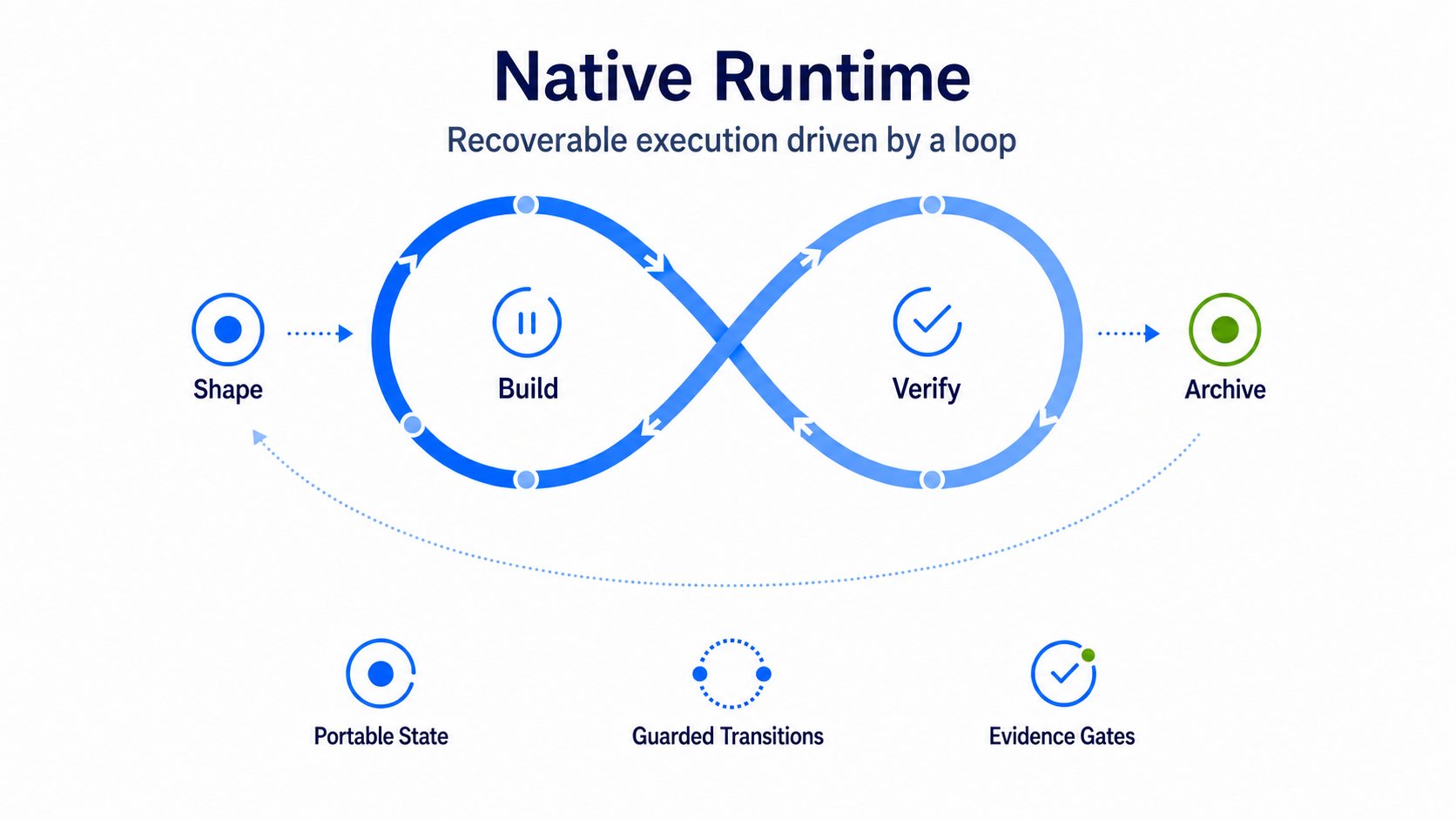
The difference from /goal
A Native Loop is also a Goal Loop. Both it and /goal] enable agents to continuously advance around verifiable endpoints. The difference lies in that /goal offers universal long-term execution capabilities; Native Loop defines fixed stages, acceptance criteria, and state management specifically for software development.
Therefore, Native upgraded the general Goal to a recoverable, collaborative, and auditable Agent development closed loop. You can also combine the two: let
/goal provide long-term continuous execution, and let Native handle the goals, workspaces, statuses, and completion determinations during the R&D process.
Let Skill return to its essence
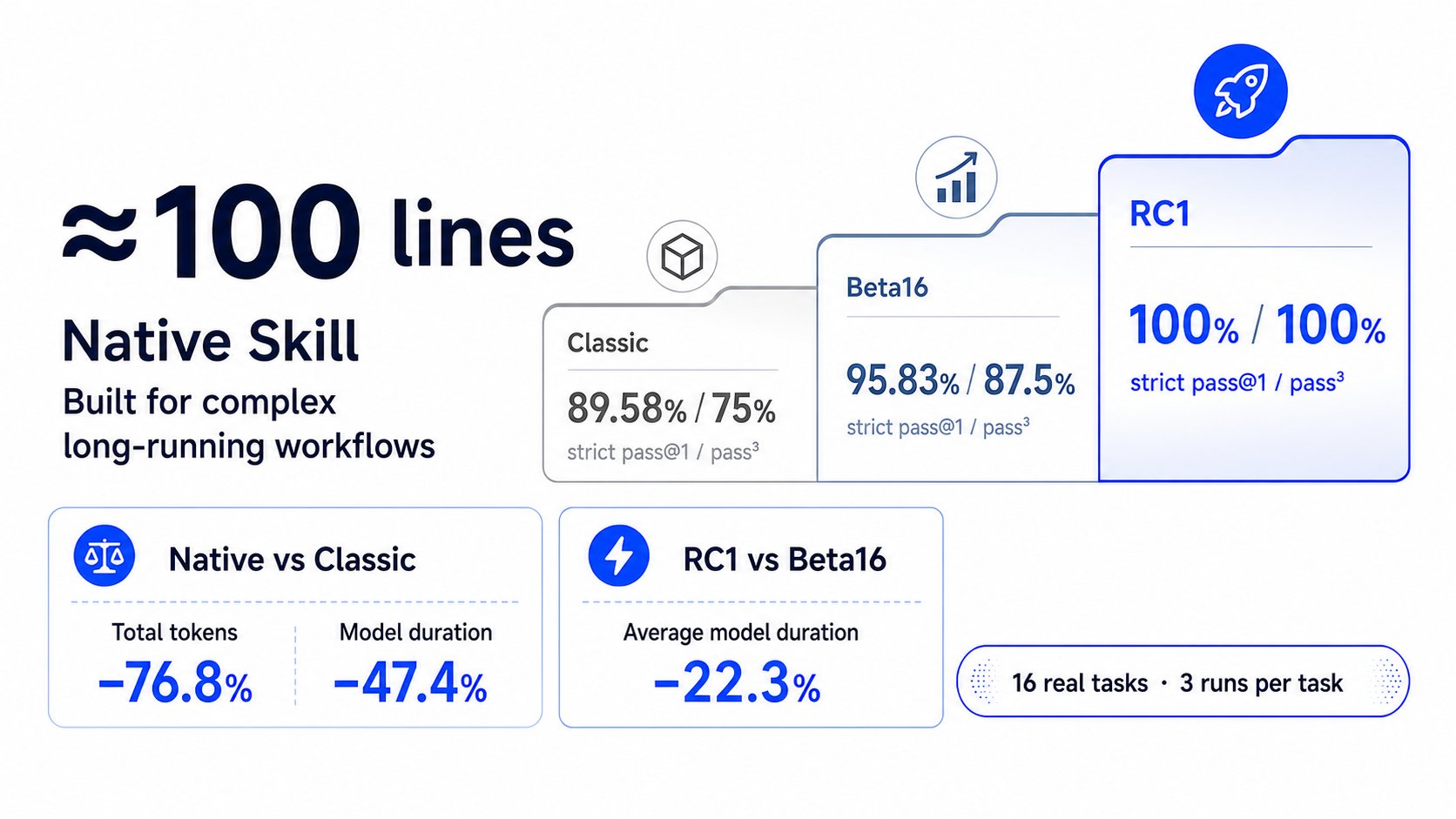
In the past, we often used skills to write a large number of engineering rules, allowing agents to develop according to fixed design, planning, TDD and review processes, such as Superpowers. When the models entered the Fable 5 and GPT-5.6 range, they already had stronger capabilities of autonomous investigation, planning and tool selection. Overly specific process regulations may instead conflict with the model’s own reasoning path. Let’s return to the essence of Skill. It itself enters the Agent Harness process as a System Prompt. At runtime, the Agent decides whether to gradually load a certain Skill by checking whether the current task matches the Skill name and desc. Therefore, Comet Native deliberately does not repeatedly write large sections of project execution rules during the Build phase. Take TDD as an example. In fact, if we need the Agent to adopt the content of TDD during implementation, we only need to install the Skill of TDD and ensure that the description of the Skill is suitable for the Coding task. When Comet Native is executed, ** The Agent will independently select the appropriate engineering Skill**. Comet Native Skill can thus focus on the workflow protocol of Native itself, while engineering methods such as TDD are provided by the corresponding Skill. This approach to ReAct Agent corresponds to the transformation of the industry’s Agent architecture from Workflow exploration to full ReAct over the past two years, and the same changes are taking place in the Skill field. With this architecture, ** more than 100 lines of Comet Native skills can carry out the work that was previously accomplished collaboratively by multiple skills of Comet Classic **.From the goal to the delivery, the four stages are automatically advanced
The four stages focus on four key outcomes: clear goals, controllable implementation, reliable acceptance, and traceable delivery. The model can independently determine the specific execution method, and the Runtime is responsible for automatically connecting the phases and pausing when you need to make a decision. For the internal components of the Runtime, see Inside the Native Runtime.Shape: Transform vague requirements into executable goals
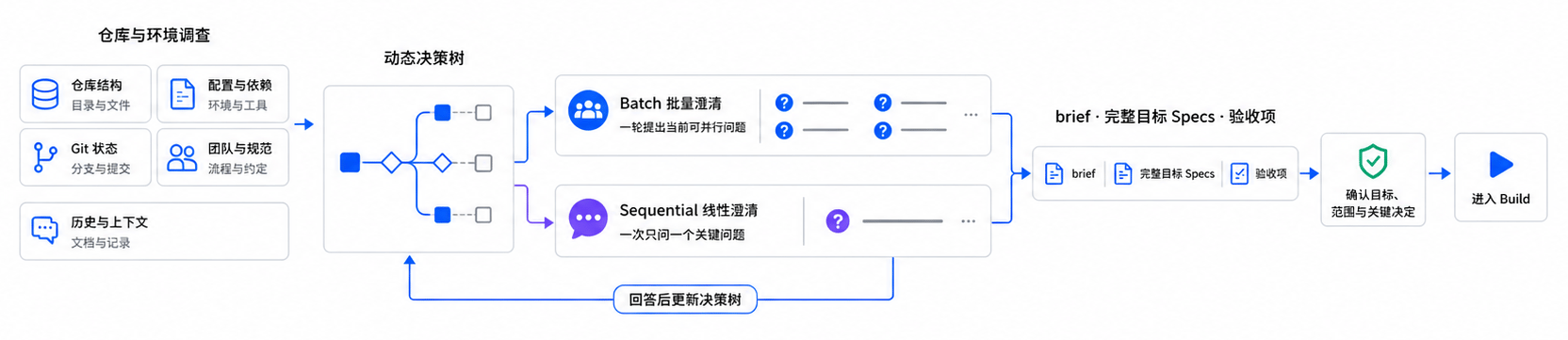
Shape will first investigate the warehouse and then dynamically raise questions that need to be confirmed based on the known information. Information is divided into three categories:- ** Verifiable facts ** : They can be identified from the code and the environment, and investigated by the Agent itself.
- ** User Decision ** : It will change the final result and needs to be confirmed by you.
- ** Implementation selection ** : It does not affect the visible results for users and is left for the model to handle.
- **Batch (Batch Clarification) ** : Display all current independent issues at once, suitable for those who wish to complete confirmation quickly.
- **Sequential (Linear Clarification) ** : Ask only one key question that has the greatest impact at a time; Update the decision tree immediately after answering and then proceed to the next level.
Build: The strong model is independently implemented, while Comet is responsible for goal advancement and delivery acceptance
After entering the Build process, the brief and Specs define “what is ultimately to be achieved”, while the model independently selects the design plan, testing method, and engineering skills based on the task. Comet is responsible for the workspace, state, phase transition, and interrupt recovery, allowing the model to focus on the code itself. Ordinary requirements can be fulfilled in one Change. When encountering large targets that are truly suitable for splitting, Native will use Supervisor Change: first, clearly define the subtasks, dependencies, and acceptance scope, and then prepare an independent worktree for the subtasks that can be started at present. Different tasks can be implemented in parallel, but they will only be integrated in sequence based on the results that are satisfied and verified.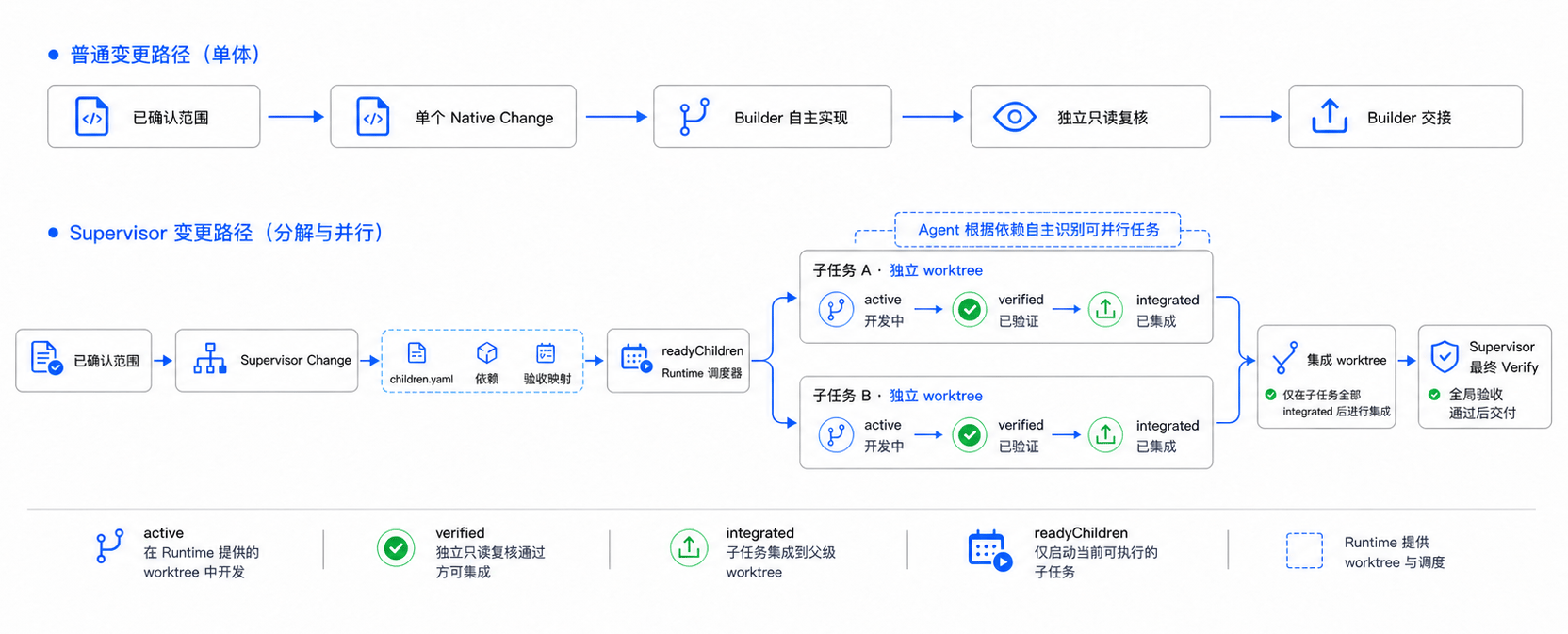
Verify: Ensure that every completion is supported by evidence
Verify takes over the candidate implementation submitted by Builder. Runtime runs the necessary checks based on the complete acceptance list and then starts a brand new read-only Verifier Subagent. It does not participate in the implementation, nor can it modify the code. It first reads the current scope’s acceptance scenarios,brief.md, the full Specs, the actual implementation and the Runtime check results, and accepts items one by one; only at the end does it treat the Builder handoff as an auxiliary clue, keeping its judgment independent. Missing items, duplicate items, unknown acceptance items or failed inspections are all judged as not passing.
If the acceptance fails, the Runtime will bring the failure reason back to the Build. When repairing, the Builder prioritizes checking the failed items and the affected scope. After the local issues are resolved, a final verification covering all acceptance items must be conducted again. When there are consecutive failures, progress stagnation, or execution errors reaching the upper limit, the Loop will pause and explain the reason to prevent further consumption of rounds.
In-depth understanding: Native Loop and Verify and Fix .
Archive: Record the results that have passed the acceptance inspection
Native is only allowed to enter the Archive when all acceptance items are passed. The Runtime will generate readableverification.md, retain requirements, Specs, acceptance evidence and final conclusions, and apply the confirmed specifications to the project documentation.
Archive will reuse the passed checks while confirming that the code, specifications, and acceptance results still match. If the requirements or implementation change before archiving, the old results will become invalid and be returned to the correct stage for reprocessing.
Finally, Comet retains the current workspace, merges the results, pushes the branch, or creates a PR based on your delivery choices. A change workspace has three isolation modes: current (completed directly in the branch and directory you are working in), branch, and worktree. Changes in a current workspace are not asked how to deliver: Comet shows the current branch and directory, archiving performs no merge, push, or PR, and the archive completes directly after you confirm. A change isolated in a branch or worktree is presented with five mutually exclusive options before archiving: keep the workspace only, merge locally, push, push and create a PR, or defer the archive. In the future, whether changing sessions or devices, it will be possible to trace how this requirement was fulfilled from the official products in the project. In-depth understanding: Archive and delivery, Product and State and Task progress and interruption recovery .
State and interruption recovery
When you close a session, switch devices, or the flow is interrupted, Comet reads the state saved in the project and continues from where it stopped. The state lives in three places:-
comet-state.yamlin the change directory: it saves the stage, Loop, acceptance, handoff, check summary, Verifier conclusion, blocking cause, the last 50 execution records, and the next step. When you switch devices or the local execution state file is missing, the Runtime rebuilds from this YAML. -
Local files under
.comet/runtime/native/:state.json, logs, locks, and transactions. These files are not synchronized across devices; if lost, they are rebuilt from the YAML as described above. -
.comet/current-change.json: it records which change the current write belongs to to avoid writing subsequent modifications to other requirements.statusandshowremain read-only and keep this pointer during the query. If the current change has been deleted or archived, you can reselect from the active changes:
The relationship with Classic
Native and Classic are two independent workflows, each targeting different model capabilities and development approaches. For how to choose between Native and Classic, see How to Select/comet forwards according to the configuration in .comet/config.yaml, and each side manages its own change, Guard, status and directory respectively.
Continue reading: Native Quick Start , Native Loop, Product and Status and Safety and Recovery .