

review_mode controls when Classic dispatches task-level code reviews in build, how many fix rounds are allowed, and how strong the final verify-stage comprehensive review is. In build: off dispatches no reviewer, standard reviews only risky tasks, and thorough reviews every task. The change’s final comprehensive code review runs only in verify; build completion does not append another reviewer.
review_mode only controls automatic reviews inside the flow. You can also invoke
/comet-review at any time for a read-only, on-demand review of the current change. It is independent of
review_mode and does not advance the workflow. It only reports correctness, security, boundary, and coverage issues in the implementation diff; it does not modify files, update state, or replace Verify.How to choose review_mode
Pick a mode by the change’s risk surface first, then by the time and tokens you can afford. hotfix/tweak default tooff, and a newly created full-workflow change defaults to standard; how each is set and where it applies is in “How to set it” below.
Full comparison of the three modes:
Cost difference between the three modes
The cost difference between the three modes is structural.off dispatches no task-level reviewer for N tasks, so it is the fastest and cheapest. standard assigns a reviewer only to tasks that hit a risk signal, and each such task gets at most 1 round of automatic fixing. thorough’s overhead is structural: N tasks mean N task-level reviewers, and each reviewer can trigger up to 2 fix rounds. For a change of 12 tasks, standard may review only a handful of risky tasks, while thorough runs 12 task-by-task reviews — several times more review-and-fix agents than standard.
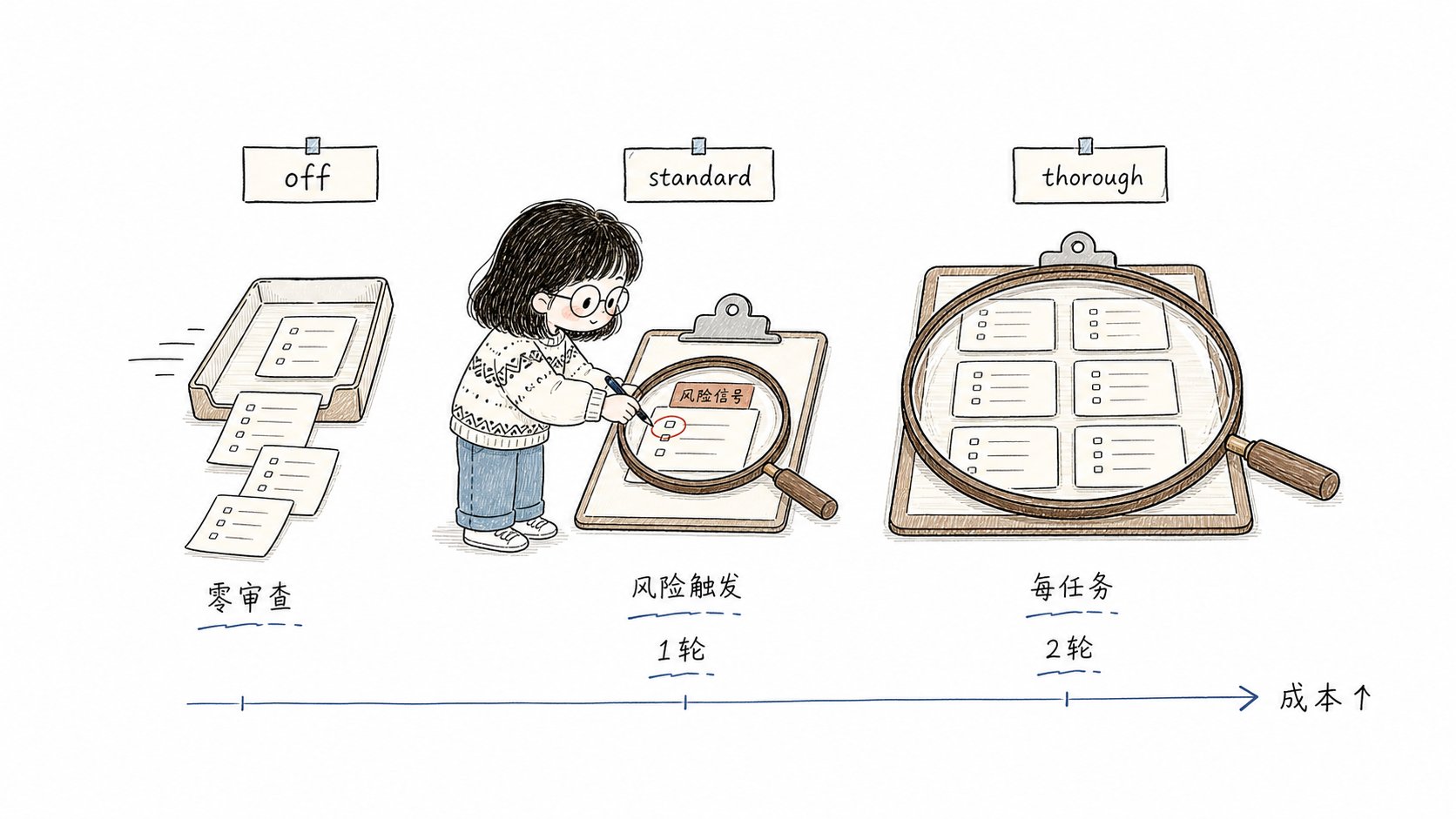
off, standard, and thorough map to different review counts and token costs
What a single task goes through
review_mode decides whether, and when, each task in the build stage gets a task-level reviewer, and how many fix rounds a review can trigger. All three modes share the same task baseline: the implementer self-tests, submits, and reports evidence (including any risk signals they found); once the coordinator verifies it, the task is checked off and the next one is dispatched. The description below follows subagent-driven-development; under executing-plans, the main session executes tasks directly and review takes a different shape — see “Final comprehensive review (verify stage)” and “Coordinating with build_mode”.
standard: review only when a risk signal is hit
Understandard, a task gets no task-level reviewer by default. After the coordinator reads the implementer’s self-report and reviews the diff, only when the self-report hits a risk signal, or the diff review reveals one, does this task get a single task-level reviewer, checking spec compliance + code quality (the risk-signal list is below). When the review finds no CRITICAL/IMPORTANT issues, the task passes verification and is checked off, then the next one starts. CRITICAL/IMPORTANT findings enter review-fix with at most 1 round, and each fix round is followed by a re-review. If the re-review still fails → mark BLOCKED, pause, and hand it to you.
thorough: every task is reviewed
Underthorough, every task gets a brand-new background task-level reviewer, again checking spec compliance + code quality. There is no batched combined review — high-risk changes need each task reviewed immediately and in focus; waiting until a batch boundary to catch problems is too costly. CRITICAL/IMPORTANT findings enter review-fix with at most 2 rounds; if the re-review still fails → mark BLOCKED, pause, and hand it to you.
off: no automatic review, rely on implementation evidence
off dispatches no automatic spec reviewer, code-quality reviewer, or review-fix agent in the build stage. Whether a task is done is decided by the implementer’s self-test, build/test evidence, the current-worktree confirmation, and the verification before check-off. off must record why the automatic code review was skipped in the persistent artifacts (tasks.md, commit body, verification report draft, and so on).
- hotfix and tweak presets default to
off. - A full workflow can also choose
offexplicitly, but the choice must be confirmed and the reason recorded before leaving build.
Final comprehensive review (verify stage)
The change’s final comprehensive code review runs only in the verify stage. After build finishes all tasks, it does not append a final reviewer and moves straight into verify.review_mode decides whether verify performs this final comprehensive review: off skips it and records the reason; standard and thorough both run it.
The executing-plans boundary: the main session executes tasks directly and has no task-level reviewers like subagent-driven-development; code review targets the finished diff, with intensity following review_mode. Under standard, no whole-change review is requested inside build, and once all tasks pass acceptance the change moves straight into verify; under thorough, a segmented review runs after every 3 completed tasks (with 3 or fewer tasks there is no in-build review), and each segmented review only covers that segment’s diff — the final comprehensive review of the whole change still runs in the verify stage.
The review in the verify stage is driven by
verify_mode (light/full) and does not consume the build review budget.
review_mode only decides whether verify triggers an automatic code review (off
skips it; standard/thorough run a lightweight code review under light
verification and rely on openspec-verify-change under full verification). The verify stage has no separate per-
review_mode “full” code review — the authoritative behavior is documented in the verify-stage pages.The three modes in one diagram
The flowchart below summarizes the task-level review and fix flow of the three modes in the build stage. Build only dispatches reviewers along the branches below and adds nothing extra; the fix rounds shown on each branch are that mode’s automatic-fix limit.Risk-signal list
Hitting any of the following marks a task as risky (decided jointly by the implementer’s self-report and the coordinator’s diff review). This is what triggers a task-level reviewer understandard:
- Cross-module / cross-subsystem coordination
- Security-sensitive surfaces: authentication, authorization, encryption, SQL, external input handling, keys/credentials
- Concurrency, locks, shared mutable state
- Data or schema migration
- Public API contract or external interface changes
- The implementer returns
DONE_WITH_CONCERNS - A single task diff over 200 lines
Boundary with Superpowers SDD
Comet’ssubagent-driven-development extension now relies only on the public task-reviewer contract of Superpowers: after the implementer finishes a task, the coordinator decides whether to dispatch a reviewer based on the task materials, the real diff, test evidence, and risk signals. Comet does not read, write, or require the internal script names, workspace paths, or private implementation details of Superpowers subagent-driven-development.
This means:
- Superpowers still provides continuous task scheduling, the pre-check plan review, file-based handoff, reviewer-neutral prompts, the “insufficient material to verify” feedback semantics, and progress reconciliation.
- Comet only takes over the reviewer-trigger policy and the review-fix budget — in other words,
review_modedecides which tasks get a task reviewer. - Documentation, recovery, and tests all follow public behavior, and shipped Skill text is not tied to Superpowers’ internal directory layout.
During the build stage, choose
off, standard, or thorough. Superpowers SDD may keep upgrading its own implementation, but it must continue to satisfy the public task-reviewer contract.Model selection for each dispatch (mandatory)
Every implementer/fixer/reviewer dispatch must name the model explicitly. Omitting it silently inherits the most expensive model in the session, slowing execution and raising cost. Follow the Model Selection rules of Superpowerssubagent-driven-development:
Omitting the model = letting it run the session’s most expensive model, which defeats the purpose of this rule.
Coordinating with build_mode
executing-plans review gate (intensity follows review_mode)
Underexecuting-plans, the main session executes tasks directly (there is no isolated implementer sub-agent), so there is no task-level reviewer like in subagent-driven-development. Code review targets the finished diff, with intensity following review_mode:
review_mode: off: no automatic code review, andrequesting-code-reviewis not loaded. Record the skip reason in the verification report draft or tasks.md, then enter verify after the tasks pass acceptance.review_mode: standard: no whole-change review is requested inside build; once all tasks pass acceptance, the change moves straight into verify.review_mode: thorough: run a segmented code review after every 3 completed tasks (against only that segment’s diff), usingrequesting-code-reviewon that segment’s commit range. With a total of 3 or fewer tasks, no in-build review runs and the change goes straight to verify. This is the closestexecuting-plansgets to task-by-task review: the main session has no isolated implementer sub-agents, so it cannot dispatch a reviewer per task.
- The
requesting-code-reviewfor a segmented review must finish loading before entering verify. - If a required review Skill cannot load, stop and report the failure; do not skip it silently.
- CRITICAL/IMPORTANT findings (security vulnerabilities, data-loss risk, build/test failures) must be fixed before entering verify.
- Non-CRITICAL findings may be accepted, but the reason and impact must be recorded in the persistent artifacts.
How reviewers work
Undersubagent-driven-development, reviews are run by brand-new background agents. A reviewer gets the full task, the implementation commit/diff, and (when TDD is on) the RED/GREEN evidence, and must check the real code directly before concluding.
The fixer is also a brand-new background agent that changes the code independently based on the review feedback.
Progress checkpoint
The coordinator maintains.comet/subagent-progress.md, recording each task’s implementation commit, changed files, RED/GREEN evidence, the selected review_mode, the review stages already passed, unresolved review feedback, and the current review-fix round (standard up to 1, thorough up to 2, off 0), plus whether the task already triggered a risky-task review under standard (a completed task review is not re-dispatched on resume).
How to set it
Priority
The resolution priority ofreview_mode:
.comet.yaml; hotfix/tweak hardcode off.
Since 0.4.0-beta.1, the default for a newly created change changed from
null (disabled) to standard
: when comet init or the new-change snapshot finds that neither the environment variable nor the project configuration sets
review_mode, it writes standard (risk-triggered task review) by default instead of no review.
Existing changes are not affected: a pre-existing full change missing this field is blocked when leaving build,
with a prompt to first run comet state set <change> review_mode <off|standard|thorough> and then continue.Project default
Edit.comet/config.yaml:
.comet.yaml when created. Note: the environment variable and the project configuration only provide defaults at the resolver layer; they do not affect a review_mode already written into a change.
A single change
In a full workflow, you choose it at build Step 3 (execution-mode selection), and it is written throughcomet-state:
Environment variable
review_mode already written into a change.
Hard constraint (full workflow leaves build)
review_mode is a hard gate of the full workflow, enforced by two independent checks:
Both layers must pass before you leave build. hotfix/tweak are exempt (they default to
off).
review_mode is not a required field, so .comet.yaml files from before 0.4.0
parse without migration. The mandatory check lives on the build → verify stage guard: files missing the field take the
compatibility path, and the field should be backfilled on recovery. Illegal values (anything other than
off/standard/thorough) are rejected by the enum validation.State-transition interactions
review_mode is a gate field of the build stage. It does not change the field effects of the transition events, but it is checked as a hard decision before build-complete. The relevant transitions:
build-complete→ callsrequireBuildDecisions(including the review_mode check), then writesphase: verify, verify_result: pending.verify-pass→ requiresverification_reportto exist withbranch_status: pending, then writesphase: archive, verify_result: pass;handledis written by Archive after the final delivery confirmation.verify-fail→ writesverify_result: fail, phase: build(a rollback; the nextbuild-completemust satisfy review_mode again).
Next steps
- Classic configuration — the review_mode field and configuration precedence
- build stage — where review_mode is used in build and how it combines with build_mode
- verify stage — the light-path review check in verify (driven by verify_mode)
- Context compression mechanism — another project-level option that affects execution cost